
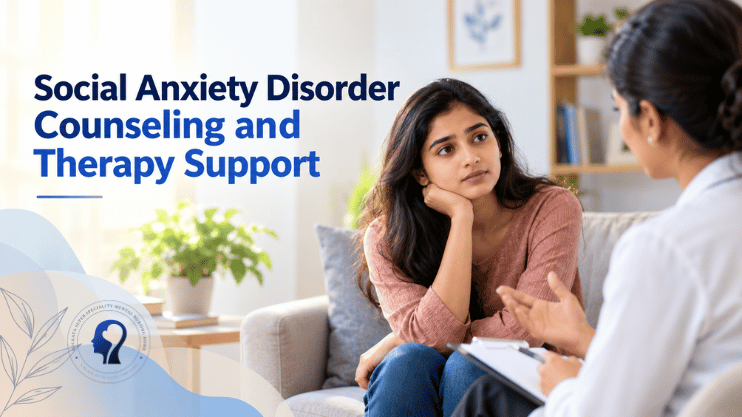
Social anxiety disorder, sometimes called social phobia, is more than feeling shy or nervous around people. It is a persistent fear of being judged, embarrassed, rejected, or closely watched in social situations. For some people, this fear becomes strong enough to affect work, education, friendships, relationships, and even simple daily activities such as making a phone call or speaking to a shopkeeper.
Some people mainly experience performance anxiety, such as intense fear before public speaking, presentations, interviews, or performing in front of others. Others experience anxiety across many everyday social situations.
The encouraging part is that social anxiety disorder is treatable. Counseling and therapy can help people understand what drives the fear, reduce avoidance, build confidence, and respond differently to anxious thoughts and physical symptoms.
The goal is not to turn someone into an extrovert. It is to help them participate in everyday life without anxiety making every decision.
How Social Anxiety Affects Daily Life
Someone with social anxiety may worry for hours or days before an interaction. They may rehearse conversations, imagine making mistakes, or fear that others will notice them blushing, shaking, sweating, or struggling to speak.
During a social situation, attention often turns inward. Instead of following the conversation, the person may think, “Do I sound stupid?” “Can they see I am nervous?” or “What if I embarrass myself?”
Afterward, they may replay the interaction repeatedly and focus on small details they believe went wrong.
This pattern can lead to avoidance. A student may stop speaking in class. An employee may avoid presentations or promotions. Someone may decline social invitations, dating opportunities, family events, or group activities.
Avoidance brings short-term relief, but it often strengthens anxiety over time. Therapy aims to interrupt this cycle.
Some people also experience panic attacks in social situations, especially when they feel trapped, watched, or unable to escape. These episodes can include rapid heartbeat, shortness of breath, dizziness, trembling, chest discomfort, sweating, or a sudden sense of losing control.
How Counseling Helps Social Anxiety Disorder
Counseling provides a structured and confidential space to understand anxiety without being judged.
A therapist may begin by exploring when the fear started, which situations trigger it, what thoughts appear during social interactions, and how much the anxiety is affecting daily functioning.
They may also ask about depression, panic attacks, past bullying, trauma, self-esteem, substance use, family stress, and other mental health concerns that can overlap with social anxiety.
Talk therapy helps people put their fears into words, understand patterns, and gradually develop healthier responses. Good therapy does not simply tell someone to “be more confident.” It identifies the specific thoughts and behaviors that keep anxiety going.
Therapy sessions may also explore how family members respond to the anxiety. Well-meaning relatives sometimes provide so much reassurance or help with avoidance that anxiety becomes harder to challenge. In other cases, family members can provide valuable emotional support and encouragement during recovery.
Cognitive Behavioural Therapy for Social Anxiety
Cognitive behavioural therapy is one of the best-established treatments for social anxiety disorder.
It looks at the connection between thoughts, emotions, physical reactions, and behavior.
For example, someone may automatically think, “If I pause while speaking, everyone will think I am incompetent.” That thought increases anxiety, which may cause sweating or trembling. The person then avoids speaking, which prevents them from discovering that the feared outcome may not happen.
One important part of cognitive behavioural therapy is Cognitive Restructuring. This involves identifying exaggerated or unhelpful thoughts and examining the evidence for and against them.
The goal is not to replace every anxious thought with a positive one. It is to develop a more balanced interpretation of social situations and reduce the habit of treating every interaction as a threat.
Over time, this can reduce self-consciousness and help people focus more on the actual conversation rather than on imagined judgment.
Exposure Therapy and Gradual Confidence Building
Exposure therapy is often an important part of treatment.
The word “exposure” can sound intimidating, but properly conducted exposure is gradual and planned. The person is not suddenly forced into their most frightening situation.
A therapist may help create a hierarchy of feared situations, starting with easier steps and gradually moving toward more difficult ones.
Someone who fears talking to strangers may begin by making brief eye contact, then asking a simple question, then having a short conversation, and later participating in a group discussion.
Someone with performance anxiety may start by speaking in front of one trusted person before gradually moving toward larger audiences.
The purpose is to learn that anxiety can be tolerated and that feared outcomes are often less severe than expected.
Repeated practice also helps reduce the belief that anxiety must disappear before a person can act. Confidence often grows after action, not before it.
Social Skills Training, Support Groups, and Emotional Support
Not everyone with social anxiety lacks social skills. Many people communicate perfectly well when they feel comfortable.
However, some people have had so little practice that they genuinely feel unsure about starting conversations, maintaining eye contact, expressing disagreement, or handling awkward pauses.
In these cases, social skills training can be useful. Therapy may involve role-play, practicing introductions, asking questions, expressing needs, setting boundaries, or handling conflict.
A support group can also help some people feel less alone. Hearing how others manage social phobia can reduce shame and provide practical ideas for coping. Group settings may also create a structured opportunity to practice social interaction in a safer environment.
Family members can provide emotional support by encouraging gradual progress without forcing the person into situations they are not ready for. Support is most helpful when it reinforces coping rather than avoidance.
Mindfulness, Relaxation Techniques, and Physical Anxiety Management
Social anxiety often includes physical symptoms such as a racing heart, trembling, sweating, dry mouth, nausea, dizziness, or muscle tension.
Relaxation techniques may help reduce some of this physical arousal. Slow breathing, progressive muscle relaxation, grounding exercises, and mindfulness can help some people feel more settled before or during a difficult situation.
However, these techniques should not become a way of avoiding anxiety.
If a person believes, “I must calm down completely before I can speak,” the coping strategy can accidentally reinforce the idea that anxiety itself is dangerous.
A healthier goal is learning, “I can feel anxious and still continue.”
Can Online Therapy Help Social Anxiety?
Online therapy can be useful for people who struggle to attend appointments in person because of severe social fear, travel difficulties, or limited access to local services.
Video-based therapy can still include cognitive behavioural therapy, Cognitive Restructuring, exposure planning, relaxation techniques, and regular follow-up.
For some people, starting with online therapy may feel more manageable and can serve as a bridge toward greater confidence in face-to-face situations.
However, treatment should still be delivered by a qualified mental health professional, and severe symptoms may require in-person assessment.
When Medication May Be Added to Therapy
Some people improve significantly with therapy alone. Others may benefit from medication alongside counseling.
Certain antidepressant medications, including selective serotonin reuptake inhibitors and serotonin-norepinephrine reuptake inhibitors, are commonly used for social anxiety disorder.
Medication may be considered when symptoms are moderate to severe, interfere significantly with daily life, occur alongside depression, or make it difficult to participate in therapy sessions.
Medication should be prescribed and monitored by a qualified doctor or psychiatrist. It may take time to work, and side effects need to be reviewed.
Medication usually works best when it supports broader treatment rather than becoming the only strategy.
How Long Does Therapy Take?
There is no fixed timeline.
Some people notice meaningful improvement within several weeks. Others need longer, especially when anxiety has been present for years or occurs alongside depression, trauma, panic attacks, or other conditions.
Progress is rarely perfectly linear.
Someone may become comfortable speaking in small groups but still struggle with public speaking. Another person may start attending social events but still experience intense worry beforehand.
These are not signs that therapy has failed.
Improvement often means the person is doing more of what matters despite some anxiety still being present.
When Social Anxiety Needs Professional Treatment
Consider counseling if fear of judgment repeatedly leads you to avoid social situations, affects work or studies, interferes with relationships, or causes significant distress.
You may also benefit from professional help if you rely on alcohol or other substances to feel comfortable socially, repeatedly experience panic attacks, or have become increasingly isolated.
A mental health professional can also determine whether another condition may be contributing.
Depression, panic disorder, trauma-related conditions, autism spectrum conditions, body dysmorphic disorder, and substance use can sometimes overlap with social anxiety.
Accurate assessment helps make therapy more effective.
What Recovery Can Look Like
Recovery does not mean becoming fearless.
A person may still feel nervous before a presentation, interview, date, or unfamiliar social event. The difference is that anxiety no longer determines what they avoid.
Someone may speak in a meeting even while their heart is racing. They may attend a gathering without spending the entire evening planning an escape. They may make a mistake in conversation and move on rather than replaying it for hours.
That is meaningful progress.
The aim of therapy is not to remove every uncomfortable feeling. It is to help people live more freely despite them.
A Practical Takeaway
Social anxiety disorder, or social phobia, can quietly limit education, careers, friendships, relationships, and everyday independence.
Counseling and therapy can help by reducing avoidance, challenging exaggerated fears, improving coping skills, and gradually rebuilding confidence in real social situations.
Cognitive behavioural therapy, Cognitive Restructuring, and exposure therapy are among the most useful approaches. Social skills training, relaxation techniques, online therapy, support groups, and emotional support from family members may also help depending on the individual.
The earlier social anxiety is addressed, the easier it may be to prevent avoidance from becoming deeply established.
Medical Disclaimer
This article is for general education and does not diagnose social anxiety disorder or replace professional medical or psychological advice. Social anxiety symptoms can overlap with other psychiatric, neurological, developmental, and medical conditions. Treatment should be based on an individualized assessment by a qualified mental health professional. If anxiety is accompanied by severe depression, suicidal thoughts, substance misuse, or an inability to remain safe, seek urgent professional care.

Dr. Sagnik Mukherjee, a distinguished Consultant Neuro-Psychiatrist with credentials including an MBBS and MD, leads the expert team at Kolkata Super Speciality Mental Nursing Home. As a renowned consultant psychiatrist and de-addiction specialist in Kolkata, Dr. Mukherjee is highly regarded for his extensive experience and expertise in the field of mental health. He earned his MBBS from Calcutta National Medical College and his MD from SVS Medical College, demonstrating his commitment to excellence in the medical field. Driven by a profound passion for mental health, his areas of specialization encompass child and adolescent psychiatry, addiction treatment, schizophrenia, depression, and various anxiety disorders. At our state-of-the-art facility, your well-being is our top priority, and we provide personalized care within a supportive environment. To schedule an appointment with Dr. Sagnik Mukherjee and experience the highest standard of mental health care, please contact us at 9062999922 or visit our mental hospital. Your mental health matters to us, and we are here to support you on your journey to well-being.