
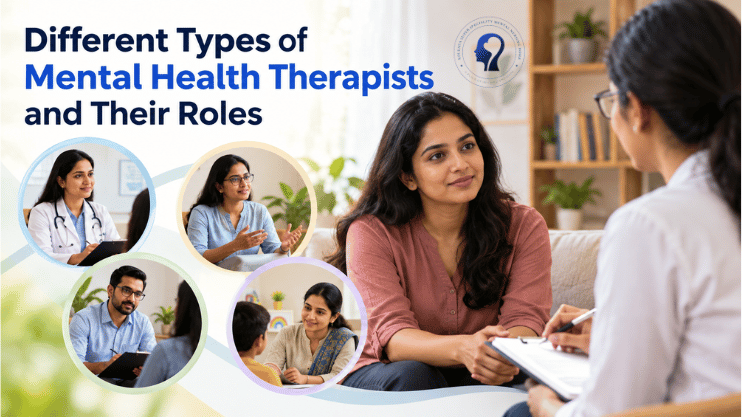
Finding the right mental health professional can be confusing because terms such as therapist, counselor, psychologist, social worker, and psychiatrist are often used as though they mean the same thing.
They do not.
Different professionals receive different training, work within different scopes of practice, and may focus on different types of problems. Some are especially useful for individual therapy, some for family or relationship problems, some for social and practical challenges, and some for psychological assessment and more complex mental health conditions.
It is also important to understand that titles such as Licensed Professional Counselor, Licensed Marriage and Family Therapist, and Licensed Clinical Social Worker are mainly used in countries such as the United States. In India, professional titles, qualifications, registration requirements, and scopes of practice differ. Clinical psychologists, for example, fall within professional registration structures administered by the Rehabilitation Council of India.
So, rather than choosing a therapist based only on a title, it is better to understand what each type of professional actually does.
1. Licensed Professional Counselor or Mental Health Counselor
Licensed Professional Counselors, often called LPCs, and Licensed Mental Health Counselors, or LMHCs, are commonly used professional titles in the United States. These professionals typically have graduate-level training in counseling and provide psychotherapy for a wide range of emotional and mental health concerns. (NAMI)
Their work often focuses on practical coping strategies, emotional regulation, life transitions, stress, grief, anxiety, depression, relationship concerns, and personal development.
A counselor may help someone identify unhelpful thought patterns, understand emotional triggers, improve communication, set boundaries, and build healthier coping skills. Depending on their training, they may use approaches such as cognitive behavioral therapy, mindfulness-based interventions, supportive counseling, or other structured forms of psychotherapy.
Counselors are often a good fit when the main goal is regular talk therapy and support with emotional or behavioral difficulties.
In India, however, the title counselor does not map directly onto the U.S. LPC or LMHC licensing system. Patients should therefore check the professional’s academic qualifications, supervised clinical training, experience, and area of practice rather than assuming that similar-sounding titles indicate identical credentials.
2. Licensed Marriage and Family Therapist
Licensed Marriage and Family Therapists, or LMFTs, are trained to look at mental health through a relational and family-systems perspective. They typically hold graduate-level qualifications in marriage and family therapy or a related field and receive specialist training in working with couples and families.
Their focus is not simply on one person’s symptoms. They examine how relationships, communication patterns, family roles, conflict, attachment, parenting, and life transitions affect mental health.
For example, a person experiencing anxiety may also be dealing with repeated family conflict. A teenager’s behavioral difficulties may be influenced by communication patterns at home. A couple may experience emotional distress because of unresolved conflict, caregiving pressures, infertility, financial stress, or major life transitions.
In these situations, a therapist trained in family or relationship work may help everyone understand how patterns are being maintained and how communication can improve.
This does not mean family therapy is about blaming parents, partners, or relatives. Good therapy focuses on patterns rather than assigning fault.
Again, LMFT is primarily a U.S. licensing designation. In India, professionals providing couples or family therapy may come from backgrounds in psychology, psychiatry, psychiatric social work, counseling, or related mental health disciplines. Patients should look carefully at qualifications and experience in relationship or family work.
3. Licensed Clinical Social Worker
Licensed Clinical Social Workers, commonly called LCSWs in the United States, combine psychotherapy with a broader understanding of social, family, and environmental factors that affect mental health. Clinical social workers generally have graduate training in social work and additional supervised clinical experience.
Their strength is that they often look beyond symptoms.
A person with depression may also be facing unemployment, housing problems, family conflict, financial stress, caregiving responsibilities, or difficulty accessing healthcare. A clinical social worker may provide psychotherapy while also helping the person navigate practical resources and support systems.
This broader perspective is particularly valuable in mental health because social factors can have a major influence on recovery.
Clinical social workers may work in hospitals, community mental health services, rehabilitation programs, schools, addiction services, and private practice. They may help with depression, anxiety, trauma, substance-related problems, family difficulties, chronic illness, and social adjustment.
In India, psychiatric social workers and other trained social work professionals may perform related roles in hospitals and mental health settings, but the exact qualifications and regulatory structure differ from the American LCSW system.
4. Psychologist
Psychologists are trained in human behavior, emotion, cognition, psychological assessment, and psychotherapy. In many international systems, psychologists receive advanced postgraduate or doctoral-level training, and some specialize specifically in clinical psychology.
A psychologist may work with conditions such as depression, anxiety disorders, obsessive-compulsive disorder, trauma-related problems, personality difficulties, eating disorders, learning problems, behavioral concerns, and relationship difficulties.
One major difference is psychological testing.
Psychologists with appropriate training may conduct structured assessments of intelligence, personality, attention, memory, learning, emotional functioning, or other areas. This can be useful when the diagnosis is unclear or when clinicians need a more detailed understanding of cognitive or behavioral functioning.
Clinical psychologists may also provide psychotherapy using evidence-based approaches such as cognitive behavioral therapy, behavior therapy, trauma-focused interventions, or other specialized methods.
In India, clinical psychologist is a regulated professional category under the Rehabilitation Council of India, and appropriately qualified professionals are registered in the Central Rehabilitation Register.
This is particularly important when someone is seeking formal psychological assessment or treatment for a complex mental health condition.
How Is a Psychiatrist Different From These Therapists?
A psychiatrist is a medical doctor specializing in mental health.
Unlike most therapists, psychiatrists can prescribe psychiatric medication and assess how medical conditions, neurological problems, medication effects, and biological factors may contribute to mental health symptoms. Psychiatrists may also provide psychotherapy, although in many settings their primary role involves diagnosis, medication management, risk assessment, and treatment planning.
Someone with mild situational stress may benefit mainly from therapy. Someone with severe depression, bipolar disorder, psychosis, repeated panic attacks, severe obsessive-compulsive symptoms, suicidal thoughts, or complicated medication needs may require psychiatric assessment as well.
Many patients benefit from both.
A psychiatrist may manage medication while a psychologist or other appropriately trained therapist provides regular psychotherapy. These roles are complementary rather than competing.
Which Mental Health Professional Should You Choose?
The right choice depends on what you need.
If your main concern is stress, coping, grief, relationship difficulties, or life transitions, counseling or psychotherapy may be appropriate.
If the main problem involves a couple, parenting, communication, or family conflict, a therapist with specific family or relationship training can be useful.
If mental health difficulties are closely tied to practical, social, financial, family, or community problems, a trained social work professional may provide particularly valuable support.
If you need structured psychotherapy, psychological assessment, cognitive testing, or help with more complex psychological difficulties, a qualified clinical psychologist may be appropriate.
If symptoms are severe, recurrent, associated with major functional decline, involve suicidal thoughts, psychosis, mania, severe substance use, or may require medication, a psychiatrist should be involved.
Sometimes the most appropriate answer is not one professional, but a multidisciplinary team.
What to Check Before Starting Therapy
Professional titles alone do not tell you whether someone is the right therapist for you.
Ask about their qualifications, training, professional registration where applicable, experience with your specific concern, and the type of therapy they provide. It is reasonable to ask how treatment works, what goals you will be working toward, and how progress will be reviewed.
A strong therapeutic relationship also matters. You should feel able to discuss difficult topics without being shamed, pressured, or dismissed.
At the same time, therapy should have professional boundaries. Be cautious if someone promises a guaranteed cure, discourages appropriate medical care, pressures you to stop prescribed medication, or claims to treat serious psychiatric conditions without suitable qualifications.
Qualified Psychiatric Hospital in Kolkata
The term therapist covers several different professions.
Licensed Professional Counselors generally focus on counseling and psychotherapy. Licensed Marriage and Family Therapists specialize in relationships and family systems. Licensed Clinical Social Workers combine mental health treatment with attention to social and practical needs. Psychologists provide psychotherapy and may also conduct advanced psychological assessment.
These exact licensing titles are largely based on systems outside India, so patients in Kolkata should pay close attention to local qualifications, registration, clinical training, and scope of practice.
The best mental health professional is not simply the one with the most impressive title. It is the appropriately qualified professional whose skills match the problem you are trying to address. Contact KSSM if you require more information.
Medical Disclaimer
This article is for general education and does not replace individualized medical or mental health advice. Professional titles, licensing requirements, and scopes of practice vary by country and jurisdiction. If you have severe depression, suicidal thoughts, psychosis, mania, significant substance use, or another urgent mental health concern, seek assessment from a qualified mental health professional promptly.

Dr. Sagnik Mukherjee, a distinguished Consultant Neuro-Psychiatrist with credentials including an MBBS and MD, leads the expert team at Kolkata Super Speciality Mental Nursing Home. As a renowned consultant psychiatrist and de-addiction specialist in Kolkata, Dr. Mukherjee is highly regarded for his extensive experience and expertise in the field of mental health. He earned his MBBS from Calcutta National Medical College and his MD from SVS Medical College, demonstrating his commitment to excellence in the medical field. Driven by a profound passion for mental health, his areas of specialization encompass child and adolescent psychiatry, addiction treatment, schizophrenia, depression, and various anxiety disorders. At our state-of-the-art facility, your well-being is our top priority, and we provide personalized care within a supportive environment. To schedule an appointment with Dr. Sagnik Mukherjee and experience the highest standard of mental health care, please contact us at 9062999922 or visit our mental hospital. Your mental health matters to us, and we are here to support you on your journey to well-being.