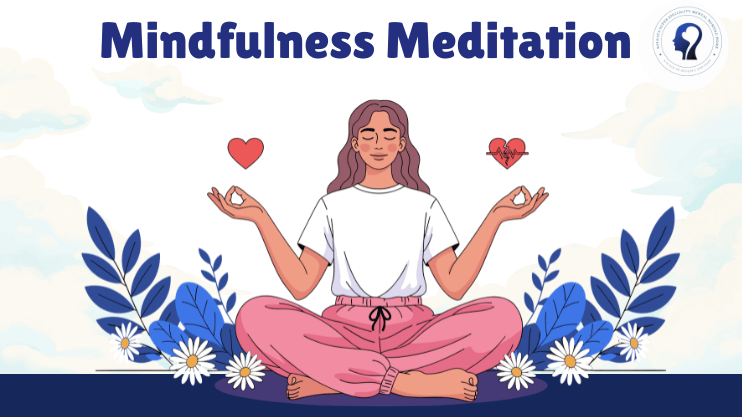
Mindfulness meditation is not about forcing a blank mind. It’s about learning to pay attention to the present moment, on purpose, with less judgment. Some days feel calm. Some days feel noisy. Both are part of a real meditation practice.
How Mindfulness Meditation Should be Practiced
If you’re starting, simplicity wins. Five to ten minutes done consistently is often more helpful than one long session you never repeat.
Step 1: Set a Time and Place
Choose a small, realistic time window, ideally the same time each day. Pick a quiet, comfortable spot where you’re less likely to be interrupted. Set a timer for five to ten minutes to begin.
A timer helps because it removes time-checking, which is one of the easiest ways mind wandering pulls you away from practice.
If sitting in silence feels challenging at first, start with guided meditation. A short guided track can give your attention a structure to follow while you build confidence.
Step 2: Find a Comfortable Posture and Notice Physical Tension
Sit on a chair with both feet on the floor, or on a cushion if that feels better. Let your spine be upright but not stiff, like you’re alert and relaxed at the same time.
Before you focus on the breath, perform a body scan for physical tension. Many people hold stress in the jaw, shoulders, belly, or hands. You’re not trying to eliminate tension by force. You’re simply noticing what’s there and permitting yourself to allow small softening where possible.
Step 3: Set an Intention for Your Meditation Practice
Take a quiet moment to name why you’re doing this. Keep it human and simple. It could be “I’m practicing steadiness,” “I’m giving my mind a break,” or “I’m learning to respond instead of react.”
Some people find it helpful to imagine putting down a heavy bag. Your responsibilities are still there, but you’re permitting yourself to stop gripping them tightly for a few minutes.
Step 4: Practice Mindful Breathing with Deep Breaths
Bring your attention to mindful breathing. Notice where you feel the breath most clearly: air moving at the nostrils, the chest rising and falling, or the belly expanding and releasing.
If you feel restless, start with two or three deep breaths, slow and comfortable, then let the breath return to its natural rhythm. This is sometimes called breath meditation or breath meditation practice, and it’s popular because the breath is always available as an anchor.
Over time, mindful breathing can support stress regulation, and some people notice improvements in sleep quality and a calmer baseline. Research also suggests mindfulness-based treatments can help some individuals with stress-related symptoms, and may have modest benefits for measures like blood pressure in certain groups, though it should not replace medical care.
If stress, anxiety, or low mood continue despite self-help techniques, a best mental hospital in Kolkata can help you understand what level of care may be needed.
Step 5: Expect Mind Wandering and Learn the Return
Your mind will wander. That is not a mistake. Mind wandering is part of being human.
The skill you’re training is the return. When you notice you’re lost in thoughts, quietly acknowledge it and come back to the breath. Each return is a repetition, like a gentle “rep” in the gym for your attention.
If it helps, label what happened neutrally, such as “thinking” or “planning,” then return to the breath without analyzing the thought.
Step 6: Use Kindness and Simple Tools Like the Five Senses Exercise
Many people quit meditation because they judge themselves for getting distracted. Kindness is not optional here. It is what makes practice sustainable.
If your mind feels too busy for the breath, you can use a grounding tool like the five-senses exercise. Bring attention to what you can see, hear, feel, smell, and taste in the present moment. This practice helps anchor awareness when thoughts are racing or when physical tension is high.
You can also rotate between anchors: one minute of mindful breathing, then one minute noticing body sensations, then one minute listening to sounds. The goal is not perfection. The goal is gentle presence.
Step 7: Close Gently and Carry Mindfulness Into Daily Life
When the timer ends, pause for a few seconds. Notice your body, your mood, and your surroundings. Even if the session felt messy, you still practiced. That matters.
Then consider bringing mindfulness into ordinary moments. A meditation practice becomes more powerful when it shows up outside the cushion.
Mindful Eating can be one simple option. Try eating the first few bites slowly, noticing taste, texture, and hunger cues, without multitasking.
Mindful Walking is another option, and it can be especially helpful if sitting still feels difficult. In a walking meditation, you pay attention to the sensation of your feet touching the ground, the rhythm of your steps, and your surroundings, returning to those sensations whenever the mind drifts. It’s mindfulness, just in motion.
If you like structure, guided meditation sessions can help you explore these variations without overthinking the “right” way to do it.
What to Expect Over Time
With steady practice, many people report feeling less reactive, more aware of stress signals, and better able to settle at night. Improvements in sleep quality are common for some, particularly when practice becomes consistent and screen time reduces near bedtime. Others notice they catch physical tension earlier and can soften it before it escalates into headaches, irritability, or exhaustion.
Mindfulness-based treatments are also used in clinical settings for stress, anxiety, and relapse prevention support, but mindfulness is not a substitute for professional care when symptoms are severe.
Mindfulness often works best alongside psychiatric counseling when someone needs deeper help with stress, anxious thoughts, and emotional balance.
When Mindfulness Might Feel Difficult
If you have a history of trauma, panic, or severe anxiety, silence can sometimes amplify distress at first. Starting with guided meditation, keeping eyes open, practicing Mindful Walking, or using the five-senses exercise can be gentler entry points. If meditation consistently makes you feel worse, speak with a qualified mental health professional for individualized guidance.
If you have ongoing health concerns such as high blood pressure, sleep problems, panic symptoms, or depression, seek guidance from a qualified healthcare professional. If you have thoughts of self-harm, seek urgent help immediately. Kolkata Super Speciality Mental Hospital offers expert psychiatric assistance. Our trained and experienced medical professionals are well-versed in various treatments. Get in touch with us so we can get you the help you deserve.
If stress, anxiety, or overthinking continue despite self-help techniques, you can visit our neuropsychiatric clinic in Kolkata for an in-person mental health evaluation.